
 이미지 확대보기
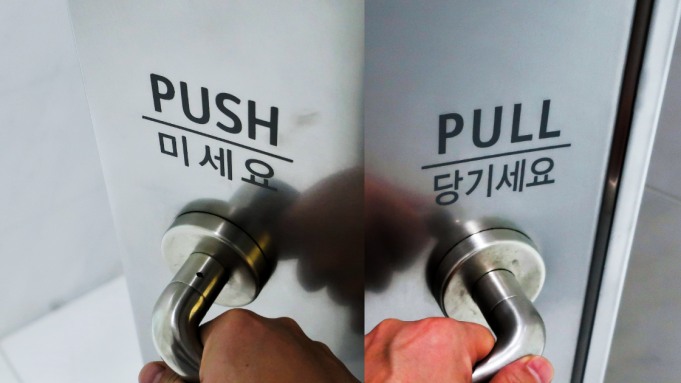
Both Miseoyo and Danggiseyo are polite imperative forms of verbs, used to give instructions in a respectful way. They’re written on doors to tell you how to open them, reflecting Korea’s emphasis on clear communication and courtesy, even in something as simple as signage.
Miseoyo (미세요): This comes from the verb milda (밀다), which means “to push.” The -seyo ending makes it a polite command, so miseoyo translates to “Please push.” When you see this on a door, it means you need to push the door to open it and enter.
Danggiseyo (당기세요): This comes from the verb danggida (당기다), meaning “to pull.” Again, the -seyo ending adds politeness, so danggiseyo means “Please pull.” This sign indicates that you should pull the door toward you to open it.
These phrases are written in a polite form because they’re addressing the general public—strangers who deserve respect, a core value in Korean culture. You’ll see them in the Hangeul alphabet (미세요 and 당기세요), often on glass doors or small signs, sometimes accompanied by arrows or icons for clarity.
The Cultural Context: Politeness in Everyday Life
The use of -seyo in miseoyo and danggiseyo reflects a key aspect of Korean culture: politeness and consideration for others. In Korea, even public signs are written with a level of respect, as if the building itself is speaking to you kindly. This aligns with the concept of jeong, the Korean spirit of warmth and connection, which extends to small interactions—like ensuring a visitor knows how to open a door without confusion. It’s a subtle but meaningful way that Korean culture prioritizes harmony and respect, even in the most mundane moments.
These words also highlight Korea’s attention to detail and user-friendly design. In a country where efficiency and clarity are valued, signs like miseoyo and danggiseyo ensure that everyone, including international travelers, can navigate public spaces with ease. While some doors in tourist-heavy areas might also have English translations (“Push” or “Pull”), many don’t, making these phrases essential for any visitor to recognize.
Why These Phrases Matter
Learning miseoyo and danggiseyo is more than just figuring out how to open a door—it’s about understanding the thoughtfulness embedded in Korean daily life. These words are a small but practical way to connect with the culture, helping you move through spaces confidently without the awkward fumble of pushing when you should pull (we’ve all been there!). They’re also a reminder of how language in Korea often carries a tone of respect, even in something as simple as a door sign.
Tips for Beginners
Pronunciation: Miseoyo sounds like “Mee-seh-yo.” The “mi” is like “me” in “meet,” and the “seyo” has a soft, rising tone at the end. Danggiseyo is pronounced “Dang-gee-seh-yo.” The “dang” sounds like “dang” in “dangle,” and “gi” is a soft “gee” like in “geese.”
Recognition: Look for these words on glass doors or small signs near the handle. 미세요 (miseoyo) has three characters, starting with “ㅁ” (m), and 당기세요 (danggiseyo) has five characters, starting with “ㄷ” (d).
Practice: When you see the sign, say the word out loud to yourself—it’ll help you remember! For example, if you see 미세요, say “Miseoyo” and push the door.
So, the next time you’re exploring a Korean city and spot miseoyo or danggiseyo on a door, you’ll know exactly what to do. It’s a small step toward feeling at home in Korea, one push or pull at a time.
team webdaily (2webdaily@gmail.com)